
Painting your car is a marriage; wrapping it is just dating.
That flexibility is exactly why vehicle vinyl wrapping has exploded in popularity. Whether you want to turn a leased Tesla into a satin black head-turner without voiding the warranty, or turn a delivery van into a revenue-generating asset, vinyl is the answer.
But not all vinyl is created equal. From distinguishing between cast and calendared film to understanding why “cheap” wraps often cost more in the long run, this guide covers the essentials of custom car wraps, commercial fleet branding, and the critical maintenance steps you need to know.
Part 1: What is Vehicle Vinyl Wrapping?
At its core, vehicle vinyl wrapping is the process of applying a pressure-sensitive, pliable vinyl film over your vehicle’s existing paint. Think of it as a second skin.
Modern vehicle wraps are high-tech PVC polymers typically 3 to 4 mils thick. Unlike a paint job, which is permanent and significantly lowers the resale value of cars (especially exotics), a wrap protects the original OEM paint underneath. When you are ready to sell the car or change the style, the vinyl is peeled off, revealing pristine paint that has been shielded from UV rays, minor scratches, and road contaminants for years.
The Critical Distinction: Vinyl Wrap vs. PPF vs Paint
Before diving deeper, it is vital to clarify a common confusion: Vinyl Wraps are not Paint Protection Film (PPF).
Vinyl Wraps are primarily for style and color change. While they offer minor protection against light scratches and UV rays, they are thin. A heavy rock chip will puncture vinyl.
PPF (Clear Bra) is a thicker (8+ mils), self-healing urethane film designed specifically for impact protection.
The Verdict: If you want to change the color of your car, get a Vinyl Wrap. If you love your current color and want to prevent rock chips on the highway, get PPF. Many enthusiasts now combine both: wrapping the car for color, then applying a layer of PPF on the front bumper to protect the wrap itself.
Here’s a full comparison table:
| Feature | Vinyl Wrap  | Paint Protection Film (PPF)  | Custom Paint  |
|---|---|---|---|
| Primary Goal | Style & Color Change To customize the look instantly. | Impact Protection To shield OEM paint from rock chips. | Restoration / Permanence To permanently fix damage or show-finish. |
| Protection Level | Low Protects against UV rays and light swirls only. | High Absorbs impacts; many feature “self-healing” heat tech. | None Brittle; will chip or scratch upon impact. |
| Material Thickness | Thin (3–4 mils) Like a Post-It note. | Thick (8–10 mils) Like a credit card. | Variable Chemical bond of primer, base, and clear coat. |
| Lifespan | 5–7 Years (Garage kept, high-quality cast film). | 7–10 Years Premium films resist yellowing for a decade. | 20+ Years Can last the life of the car with maintenance. |
| Reversibility | 100% Reversible Peel off to reveal pristine OEM paint. | 100% Reversible Peel off and replace if damaged. | Permanent Requires sanding and repainting to undo. |
| Estimated Cost | $$ ($2,500 – $5,000) | $$$ ($1,800 – $7,000+) (Front-end vs. Full Body) | $$$$ ($8,000 – $20,000+) Labor intensive. |
| Finish Options | Unlimited Matte, Satin, Color-Shift, Chrome, Carbon Fiber. | Limited Mostly Clear (Gloss/Matte/Satin). | High Gloss / Metallic Best depth and reflection. |
Part 2: The Science of Vinyl (Don’t Skip This)
This is the most technical—and important—section of this guide. If you are shopping for a wrap, you will see wild price differences. One shop quotes $1,500; another quotes $3,500.
The difference is almost always the material science: Calendared vs. Cast Vinyl.
1. Calendared Vinyl (The “Economy” Option)
Think of calendared vinyl like pizza dough. It starts as a thick ball of PVC and is squeezed through rollers (calenders) to flatten it out.
Characteristics: Thicker, cheaper to produce, and has “memory.” This means it always wants to shrink back to its original shape.
The Risk: Because it wants to shrink, it is terrible for the complex curves of a car. Over time, it will pull away from door handles and deep recesses, leading to “tenting” or lifting.
Use Case: Excellent for flat surfaces like box trucks or simple lettering, but never acceptable for a full color-change wrap on a passenger car.
2. Cast Vinyl (The “Premium” Standard)
Think of cast vinyl like a cake batter. The ingredients are mixed into a liquid and poured onto a casting sheet, then baked.
Characteristics: Extremely thin, durable, and has no “memory.” You can stretch it, heat it, and mold it over complex shapes (like mirrors and bumpers) without it shrinking back.
The Benefit: It lasts 5–7 years and removes cleanly.
The Brands: If your installer isn’t using 3M 2080, Avery Dennison SW900, KPMF, or Inozetek, ask specifically if they are using a Cast film.
Part 3: Custom vs. Commercial Wraps
While the material is similar, the intent—and the installation strategy—differs depending on your goal.
Custom Car Wraps (Aesthetics & Resale)
For the enthusiast, custom car wraps are about personalization. You aren’t limited to factory colors anymore. You can make a Ford Mustang look like a fighter jet or a Tesla Model Y look like a cyberpunk cruiser.
2026 Trends: Popular Vehicle Wrapping Colors
If you are looking for vehicle wrapping services, the palette is limitless. However, three distinct styles are dominating search trends this year:
Matte & Satin Black: The undisputed king of wraps. It hides dirt reasonably well and gives any vehicle an aggressive, modern “stealth” stance. Satin is often preferred over full matte because it has a slight sheen that highlights the car’s body lines better.
Color Shifts (Chameleons): High-gloss metallics are back. Deep midnights, violets, and “midnight purple” shifts are massive right now. These films contain metallic flakes that change color depending on the viewing angle, offering a finish that is hard to distinguish from a $15,000 custom paint job.
Carbon Fiber Accents: You don’t need to replace your hood to get the race-inspired look. Textured carbon fiber films (which actually feel like the weave) are frequently used on hoods, roofs, and mirrors to contrast against a solid body color.
Commercial Car Wrapping (ROI & Branding)
For business owners, a vehicle isn’t a toy; it’s a billboard. Commercial car wrapping is statistically one of the lowest cost-per-impression marketing channels available.
The ROI Math: A billboard in a major city might cost $3,000 a month. A full van wrap costs $3,000 once and lasts for 5 years. If that van is driven daily in traffic, it can generate 30,000 to 70,000 impressions per day. The Cost Per Thousand Impressions (CPM) is pennies compared to radio or digital ads.
The “Fleet Uniformity” Factor: Small businesses often buy used vans of different colors. Wrapping them all in a consistent brand color makes a small fleet look like a major enterprise, building instant trust with customers.
Partial Wraps: You don’t always need a full wrap. Many fleets opt for “partial wraps”—covering just the rear doors and sides—to balance impact with budget.
Part 4: The Installation Process (What Happens to Your Car?)
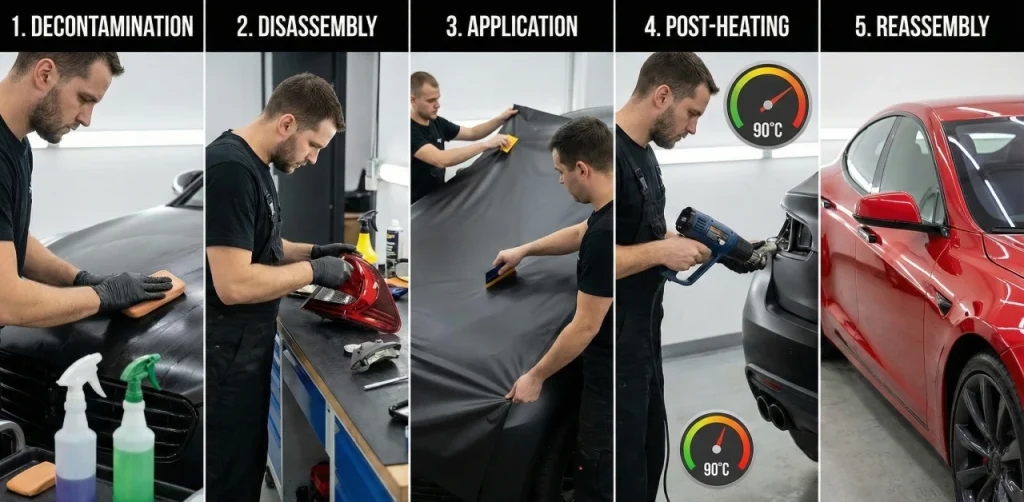
A common fear is that the installation process will damage the car. Knowledge is power here. A professional installation follows a rigorous 5-step process:
Decontamination (The Wash): The car is hand-washed, then clay-barred to remove embedded contaminants. Installers use isopropyl alcohol to strip every ounce of wax, grease, and oil. If a single fingerprint remains, the vinyl will fail.
Disassembly (The “Scary” Part): To get a seamless look, pros remove door handles, mirrors, taillights, and sometimes bumpers. This allows them to wrap the vinyl inside the edges, so you never see the original color peeking through the gaps.
Application (The Art): The vinyl is laid over the panel. Using heat guns to soften the material and squeegees to remove air, the installer shapes the film over the car.
Post-Heating (The Science): Once the wrap is on, the installer goes back over every inch with a heat gun (usually to 90°C/194°F). This “kills the memory” of the vinyl, ensuring it stays in its new shape permanently.
Reassembly: All hardware is reinstalled, and the car is wiped down for delivery.
Part 5: Pricing – What Does a Wrap Actually Cost?
This is the most common question, and the answer depends on vehicle size, material choice, and labor rates in your city.
There is high search volume for “cheap vehicle wrapping,” but as we discussed, “cheap” usually means Calendared Vinyl or dangerous cutting shortcuts. A professional wrap is an investment in skilled labor.
Estimated Price Ranges (2026 Market Rates)
| Service Type | Estimated Price Range | Best For |
|---|---|---|
| Chrome Delete | $300 – $800 | Blacking out window trim, grilles, and emblems for a sportier look. |
| Commercial Lettering | $500 – $1,500 | Simple business logos, phone numbers, and DOT numbers on doors/tailgate. |
| Partial Wrap | $1,500 – $2,500 | Fleet branding that covers rear doors and quarters for high impact at lower cost. |
| Full Color Change (Sedan/Coupe) | $2,800 – $4,000 | Standard gloss, matte, or satin wraps for average-sized vehicles (e.g., Tesla Model 3). |
| Full Color Change (Truck/SUV) | $3,500 – $5,500+ | Larger vehicles requiring more material and labor (e.g., Ford F-150, Chevy Tahoe). |
| Exotic / Specialty Material | $6,000 – $10,000+ | Chrome, color-shift, or intricate installs on supercars with complex body lines. |
Pro Tip: Wrapping door jambs (the painted inner area hidden when doors are closed) is typically an additional $500 – $1,000+ due to the extensive disassembly required.
Check out our more detailed car wrap cost article for a specific state by state breakdown.
Note: Door jambs (the painted area inside the door) are usually an extra cost, ranging from $500 to $1,000, as they require significant disassembly.
Want a specific number tailored to your car? Try our Vehicle Wrap Pricing Calculator to get a baseline estimate before you call a shop.
Part 6: Maintenance & Longevity
“How long will it last?” is the second most common question.
A high-quality Cast vinyl wrap typically lasts 5 to 7 years if vertically applied (doors) and 3 to 5 years on horizontal surfaces (hood/roof) which take the brunt of the sun.
How to Extend the Life of Your Wrap
Hand Wash Only: Automatic car washes with bristles will scratch and swirl gloss vinyl and can destroy matte finishes. Touchless washes are safer, but the high-pressure jets can lift the edges of the vinyl if you aren’t careful. The two-bucket hand wash method is always best.
Read our deep dive: The Definitive Guide on How to Wash and Maintain Your Vinyl Car Wrap. We cover the exact soaps to use, how to handle matte finishes, and the “two-bucket method” in detail.
Avoid Wax on Matte: If you have a matte or satin wrap, never use standard car wax. It contains polishing agents that will fill in the texture and create shiny splotches. Use specific “Matte Detailer” sprays.
Ceramic Coating: Yes, you can (and should) ceramic coat a vinyl wrap. It makes the wrap hydrophobic (water beads off), making it easier to clean and providing a crucial layer of UV protection to prevent fading.
Park in Shade: The sun is the enemy. Constant UV exposure will eventually “bake” the vinyl onto the car, making removal difficult. If you park outside, consider a car cover.
Removal: The End of the Lifecycle
When the wrap reaches the end of its life (usually when you see hairline cracks on the roof), it must be removed immediately.
Good Removal: If removed within the recommended lifespan, high-quality vinyl comes off cleanly with heat, leaving little to no residue.
Bad Removal: If you leave a wrap on for 10 years, it will crack and flake. Removing it becomes a nightmare that charges by the hour for labor.
Part 7: How to Find the Right Shop
Don’t just Google “vinyl car wraps near me” and pick the first result. The barrier to entry in this industry is low—anyone can buy a roll of vinyl and watch a YouTube video. But a bad install involves razor blade cuts on your paint that you won’t see until the wrap comes off years later.
Use our advanced search tool on WrapMatchPro to find verified vehicle wrap installers in your city.
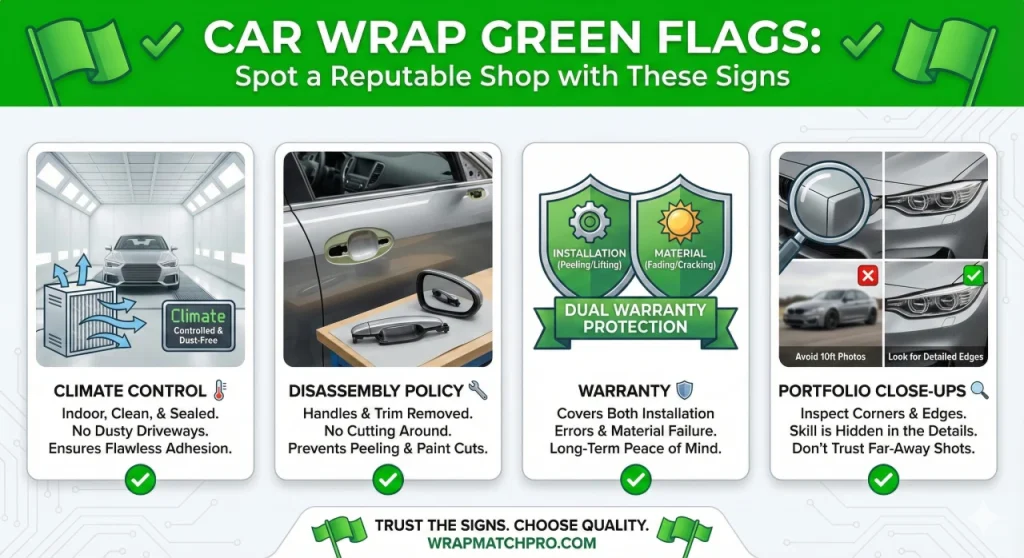
The Green Flags (What to Look For):
Climate Control: Is the shop indoor, clean, and dust-free? You cannot wrap a car professionally in a dusty driveway or an open-air garage.
Disassembly Policy: Ask them: “Do you take the door handles off?” If they say no, they are cutting around them. This creates a weak point where the wrap will peel, and increases the risk of knife cuts on your paint.
Warranty: A reputable shop will offer a warranty on the installation (peeling/lifting) on top of the manufacturer’s material warranty (fading/cracking).
Portfolio Close-Ups: Don’t just look at photos of the whole car 10 feet away. Look for close-up photos of corners, edges, and door handles. That is where the skill is hidden.
Conclusion
Whether you are looking for the stealth of a matte black wrap, the utility of a commercial fleet wrap, or just want to protect your paint, the industry has matured to offer incredible options. A wrap is one of the few automotive modifications that allows you to fully express your style (or build your brand) while actually preserving the underlying asset.
Don’t gamble with your vehicle’s finish. Browse Wrap Shops by Service Type on WrapMatchPro today to find vetted, professional installers who treat your car as well as you do.