
How Much Does a Car Wrap Cost in 2026? Real Prices, Labor & Hidden Costs
Car Wrap Cost – The Sticker Shock vs. The Reality Check
Let’s cut straight to the chase. You’re here because the paint shop quote gave you a heart attack. You walked in to get a quote on respraying your daily driver, and the estimate looked like a down payment on a house. Welcome to 2026 paint labor rates. It’s enough to make your oil pressure spike.
So, you’re looking at vinyl. You’ve seen them on the street—everything from murdered-out matte black Teslas to iridescent sports cars that look like an oil slick doing 90 mph. It looks good, it protects the factory paint, and crucially, it’s removable.
But trying to get a straight answer on “how much does a wrap cost” is like trying to diagnose an engine knock over the phone. The answer is always: “It depends on how broken it is.” We are dealing with 2026 labor costs, advanced material technology, and vehicles with more sensors and complex body lines than ever before.
Here is the no-nonsense, real-world breakdown of what it costs to wrap a car, where your money actually goes, and why the “cheap guy” is going to cost you double in the long run.
Why Car Wrap Pricing Varies (Vehicle, Vinyl & Labor)
If the shop gives you a flat price without asking what you drive, hang up. They’re selling you a sticker, not a professional installation. Think of a wrap like a custom suit. The cost isn’t just the fabric; it’s the tailoring. These three main variables dictate the final invoice.
1. The Canvas (Vehicle Size & Complexity)
This is simple physics: bigger cars cost more. Wrapping a Mazda Miata takes less material than wrapping a Cadillac Escalade. But in 2026, size isn’t the only factor; it’s complexity.
Modern cars are aerodynamic nightmares for installers. They have jagged vents, complex bumper intakes, massive fender flares, and hidden sensors that can’t be covered blindly. A sleek EV might look simple, but if the installer has to drop the bumpers and remove door handles, you are paying for those labor hours.
A flat-sided cargo van is easy. A C8 Corvette is surgery.
2. The Material (Not All Vinyl is Created Equal)
Do not buy the “Unbranded eBay Special” vinyl. You can hop online and find cheap rolls for $300, but it will fade in six months and destroy your clear coat when you try to remove it. It handles like wet newspaper during installation.
Professional shops use premium cast vinyl from top-tier manufacturers. Brands like 3M, Avery Dennison, Inozetek, and KPMF engineer films to stretch into deep recesses without popping back up. They have advanced air-release adhesives so you don’t get bubbles.
Standard gloss or matte colors are your baseline. As soon as you pick chrome or color-change wrap, the price doubles. Specialty films—brushed metals, carbon fiber textures, or iridescent finishes—cost significantly more to manufacture and are harder to install.
3. Labor Cost for Car Wraps (The Wrenching Time)
You aren’t paying for the sticker; you’re paying for the skill. The labor cost for car wraps accounts for the skilled technician with steady hands and the patience of a saint who spends 20+ hours meticulously cleaning, disassembling, heating, and tucking vinyl.
A high-quality wrap is 90% prep work. If they don’t spend a full day just washing, clay-barring, and de-greasing the car before the vinyl even touches it, run away. You get what you pay for.
4. Location, Location, Location (Car Wrap Cost By State)
There is a fourth variable that nobody likes to talk about, but it dictates your quote just as much as the car you drive: Where you live.
Labor rates aren’t national; they’re local. A shop in downtown Los Angeles is paying $10,000 a month in rent and $60/hour for a junior installer. A shop in rural Alabama has a mortgage of $800 and lower overhead. Those costs get passed directly to you.
We crunched the numbers on labor trends and shop overhead to visualize exactly where your state falls on the pricing spectrum.
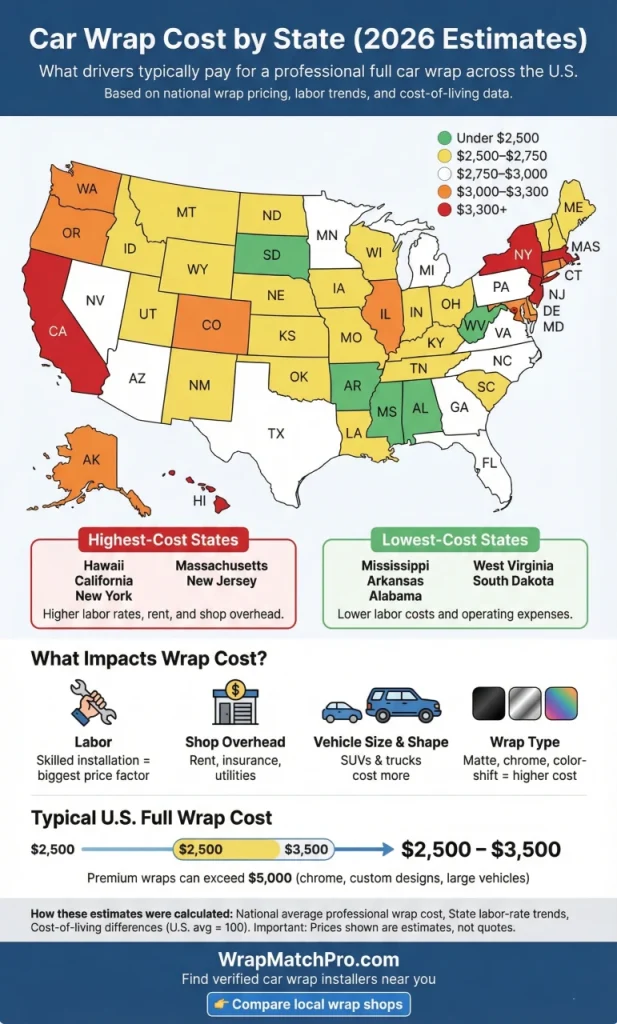
National breakdown of estimated car wrap costs based on regional labor rates and cost-of-living data.
The Takeaway:
- The “Red” Zones (CA, NY, MA, HI): If you live here, stop comparing your quotes to forum posts from guys in the Midwest. You are paying for the zip code. Expect to pay a 20-30% premium over the national average.
- The “Green” Zones (South & Midwest): You have the advantage. You can likely get a Tier 2 “Enthusiast” job for the price of a Tier 1 job elsewhere.
- The Pro Move: If you live on the border of a high-cost state (like New Jersey) and a lower-cost state (like Pennsylvania or Delaware), it might be worth the 45-minute drive to cross the state line. You could save $800 just by changing your area code.
Car Wrap Cost by Vehicle Type
Okay, let’s talk actual numbers. These are averages based on professional shops in major metropolitan areas. If you are in rural nowhere, shave off 10%. If you are in downtown LA or Manhattan, add 20%.
These prices assume a standard mid-sized sedan or small crossover (think Tesla Model 3, BMW 3-Series, Toyota Camry).
Tier 1: The “Commercial / Fleet” Job ($2,500 – $3,500)
- The Look: A basic color change using standard gloss or matte vinyl.
- The Reality: This is the entry-level for a respectable job. The shop will likely do minimal disassembly—they’ll wrap around door handles and lights rather than taking them off. You might see seams in complex areas. It looks good from 10 feet away.
Tier 2: The “Enthusiast Standard” ($3,500 – $5,500)
- The Look: A high-quality full color change using premium materials (Satin, sophisticated gloss colors, basic color-shifts).
- The Reality: This is the sweet spot for most of us. Bumpers, mirrors, and door handles come off. The wrap is tucked deep behind the weather stripping. When you close the door, you shouldn’t see the original paint color slivering through the cracks. This is the standard you should aim for if you care about your car.
Tier 3: The “Showstopper / Exotic” ($6,000 – $10,000+)
- The Look: Perfection. High-end sports cars, exotics, or complex SUVs.
- The Reality: Full disassembly is mandatory. Premium specialty films like chrome or complex textures are used. The car is likely in the shop for a full week or more. These are the guys you hire when the car is going on a magazine cover.
The “Hidden” Costs: Specialty Add-Ons
Just like buying a car, the base price is rarely the final price. Here are the options that drive the invoice up.
- Door Jambs & Inner Sills (+$1,000 – $2,500): This is the most common “sticker shock” item. A standard wrap stops at the exterior. When you open the door, you see the original paint. Wrapping the inside door jambs requires removing the doors in many cases. Most people skip it, but if you are turning a white car black, that white door jamb will bother you every time you get in.
- Chrome Wrap (+$3,000 premium): Real chrome vinyl is a nightmare to install. It is thick, unforgiving, and shows absolutely every imperfection in the bodywork underneath. Shops charge accordingly for the headache.
- Ceramic Coating for Vinyl (+$500 – $900): This is highly recommended in 2026. We have specific ceramic coatings made just for vinyl. It makes cleaning easier, protects the wrap from UV rays, and keeps it looking newer longer. You can read more about how to wash and maintain your vinyl car wrap to see why this step matters.
- Removing an Old Wrap (+$600 – $1,500+): Cheap vinyl eventually becomes expensive glue. If the previous owner bought cheap vinyl, it will come off in tiny flakes and leave residue that requires gallons of solvent to remove. Shops charge hourly for this misery.
Vinyl Wrap vs Paint Cost: The Reality Check
Why are we even doing this? Why not just paint the thing? High-quality paint jobs have crossed the $12,000 mark. According to recent industry analysis by SEMA in late 2025, environmental regulations and labor shortages have driven paint costs through the roof.
To help you decide, let’s look at the numbers. Specifically, we need to answer the two big questions: what is the vinyl wrap vs paint cost difference, and how long does a car wrap last compared to a respray?
Comparison Table: Quality Paint Job vs. Quality Vinyl Wrap
| Feature | High-Quality Paint Job | Professional Vinyl Wrap (Tier 2) | The High-Mileage Take |
| Cost (Average) | $10,000 – $15,000+ | $3,500 – $5,500 | Paint is permanent; your budget isn’t. Wrap wins on price. |
| Time in Shop | 3 – 6 Weeks | 4 – 7 Days | Less downtime means you’re back on the road faster. |
| Durability | Lifetime (with care) | 5 – 7 Years (Garage kept) | How long does a car wrap last? Long enough for a lease cycle. |
| Resale Value | Can hurt resale (suspicion of accidents) | Protects OEM paint, increasing value. | A wrap is paint protection film with an attitude. |
| Reversibility | Permanent | 100% Removable | Tired of the color? Peel it off. Try that with paint. |
The DIY Temptation: A Warning from the Garage
Look, I get it. I’m a DIY guy. I change my own oil, I do my own brakes. But wrapping an entire car is a different beast.
I have seen too many guys buy $400 worth of vinyl and a $20 heat gun from the hardware store, thinking they’re going to save four grand. It always ends the same way: screaming profanities in the garage. The bumpers look like wrinkled Saran Wrap, and they slice their clear coat with an X-Acto knife because they don’t know how to use “knifeless tape.”
You will end up tearing it all off in frustration. You’ll be out $400 and 30 hours of your life, and then you’ll have to pay a professional to fix your mess. For more details on why this is harder than it looks, check out our Guide to Vehicle Wrapping.
Do yourself a favor: stick to changing your oil. Let the pros handle the vinyl.
FAQ: The Quick-Shift Guide to Car Wrap Cost
If you skipped the technical breakdown because you just want the “too long; didn’t read” version, here it is. These are the answers to the questions my inbox gets flooded with every week.
How much does it cost to wrap a car?
Expect to pay between $3,500 and $5,500 for a standard mid-sized sedan. If you drive a large SUV, a truck, or something with complex body lines (like a Corvette), that number will climb to $6,000+. If you find a quote under $2,500 for a full color change, run. They are cutting corners on labor or using cheap vinyl that will turn your paint into a glue trap.
Is wrapping a car cheaper than painting?
Yes, significantly. A high-quality, professional respray that matches factory standards starts at $10,000 to $12,000 in 2026 due to labor rates and environmental regulations. A top-tier wrap costs roughly one-third of that. Plus, a wrap protects your original paint, whereas a repaint permanently alters the vehicle (often lowering its resale value).
Is ceramic coating a wrap worth the extra cash?
If you hate scrubbing dead bugs, absolutely. Vinyl is softer than clear coat, meaning bird droppings and bug guts can etch into it faster than paint. A ceramic coating adds a hardened, hydrophobic layer that makes washing the car significantly easier and extends the life of the vinyl by blocking UV rays. It usually adds $500–$900 to the bill, but it buys you a year or two of extra life on the wrap. Think of it as buying an extended warranty for your sticker.
Is Wrapping a Car Worth It? Final Thoughts
A wrap is significant money, but the verdict is clear. Is wrapping a car worth it? Absolutely – if you want the best bang-for-your-buck modification that completely transforms a vehicle while protecting the asset. It’s cheaper than a new car, cheaper than paint, and keeps your resale value intact.
But the quality of the installation is everything. The material is only 20% of the equation. You are hiring the installer, not buying the vinyl.
Don’t shop based on the lowest price tag. Shop based on portfolios, reviews, and the cleanliness of their shop. When you’re ready to find a qualified crew that won’t hack up your ride, use our directory to Find Vehicle Wrap Shops & Installers in your city.
Also check model-specific cost guides:

