
How much does the fleet wrap cost? Stop Guessing, Start Budgeting
There’s a moment every fleet owner knows too well: the quote lands in your inbox, the number looks great, and your gut says run. That feeling is earned. In the world of commercial fleet wrap pricing, blind quotes are the quickest way to buy regret by the roll.
Here’s the truth nobody puts on the invoice: the cheapest quote is usually the most expensive mistake. Vinyl that shrinks, adhesive that ghosts your paint, edges that lift like a bad toupee at highway speed—those costs show up later, when the truck is off the road and your brand is peeling away in public.
The golden rule is simple and unfashionable: budget for value, not price. Think in cost per year, not upfront cost. A well-installed commercial truck wrap that lasts five years is cheaper than a bargain job you replace twice. This guide exists to replace guesswork with numbers – and to help you buy once, cry never.
Use our free car wrap cost calculator to estimate the cost of your fleet wrap
3 Factors that dictate the price
Factor 1: Material Grade (The Chemistry of Failure)
The price difference between a $2,000 wrap and a $4,000 wrap is often microscopic – literally. It comes down to how the vinyl was manufactured.
- Cast Vinyl (The “Liquid” Standard): This material starts as a liquid. It is poured onto a casting sheet and baked. Because it was never stretched during manufacturing, it has no molecular memory. You can stretch it over a rivet, heat it into a deep door channel, or wrap it around a bumper, and it stays there. It is “dead” material.
- The Payoff: It lasts 5–7 years and, crucially, removes cleanly. Brands to look for: 3M 2080, Avery Dennison MPI 1105.
- Calendered Vinyl (The “Dough” Trap): This starts as a solid ball of plastic that is squeezed through rollers (calenders) to flatten it out—like pizza dough. The problem? Like dough, it has a memory. It wants to shrink back to its original shape.
- The Failure Mode: Put this on a flat box truck, and it might be fine. Put it on a curved Sprinter van, and within six months, you will see “tenting” (where the vinyl lifts out of the grooves) and “adhesive rings” (black lines of glue exposed as the vinyl shrinks). It saves you money today and costs you your brand image tomorrow.
Factor 2: Coverage Area (The Art of the Partial)
Don’t confuse “coverage” with “impact.” You aren’t paying for vinyl by the pound; you are paying for attention.
- The Full Wrap: This covers 100% of the painted surfaces. It is necessary if you need to change the color of the fleet (e.g., turning white vans into “DHL Yellow”). It offers the best protection for the paint underneath but commands the highest material cost.
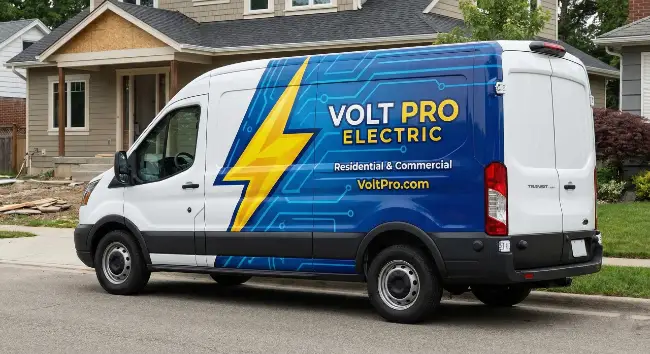
- The Strategic Partial (¾ or ½): This is the ROI Champion for commercial fleets. A skilled designer uses the vehicle’s factory base color (usually white) as the background canvas. By wrapping the rear 75% of the vehicle and “fading” into the white front, you get the look of a full custom graphic for 60% of the price.
- The Trick: The design must be intentional. If it looks like a sticker slapped on the side, it looks cheap. If the graphics flow with the body lines, the human eye fills in the gaps, and it registers as a premium branding package.
Factor 3: Vehicle Complexity (The “Knifing” Danger)
Labor is usually 50% of the invoice. Why? Because a vehicle is not a billboard. It is a machine with moving parts, sensors, and weatherproofing.
- The “Hardware” Factor: A cheap shop wraps over door handles and tail lights, or trims closely around them. This creates weak points where water enters and peeling starts. A pro shop disassembles the vehicle. They remove the door handles, mirrors, emblems, and lights. They wrap the panel fully, then reinstall the hardware on top. This takes hours of extra labor, but it ensures the wrap looks like paint—seamless and locked down.
- The Curve Penalty: A 26-foot box truck is massive, but it is flat. An installer can lay ten feet of vinyl in minutes. A Ford Transit Connect or RAM ProMaster has deep recesses and compound curves. The installer has to feed the vinyl into those channels inch by inch, then “post-heat” the material to 200°F to set the memory.
- The Reality: A small, curvy van often costs more to wrap than a large, flat truck because the labor intensity is doubled. Flat panels are honest; curves are expensive.
2026 Commercial Fleet Wrap Pricing Guide
By now you know why prices vary; now let’s talk about what people are actually paying in 2026. The numbers below aren’t unicorn deals or horror stories—they’re real-world ranges pulled from working shops, real fleets, and vehicles that earn their keep instead of posing for photos.
Think of these figures as ballpark seating, not an assigned chair. Design complexity, regional labor rates, and material choices will move the needle, but if a quote lands wildly outside these ranges, it deserves a second look—either because you’re being upsold, or because something important is being left out.
We’ll break it down by vehicle type, because a commercial fleet wrap is never “one price fits all.” A box truck is a rolling billboard. A van is a puzzle of curves and cutlines. A semi is a long-haul endurance test. Each tells a different pricing story—and each rewards smart budgeting in its own way.
| Vehicle Category | Wrap Level / Type | Estimated Cost | The “Why” & ROI Factor |
| Commercial Vans (Cargo, Sprinter, Transit) | “Tradesman Special” (Spot Graphics) | $500 – $1,200 | Logos, DOT numbers, and phone numbers. Clean, legal, and effective. |
| Partial Wrap | $1,800 – $2,800 | High ROI. The sweet spot for fleets—maximum visibility on high-impact zones. | |
| Full Color Change | $3,500 – $5,000+ | A statement piece with higher install complexity. Pro Tip: Skip the roof wrap unless advertising to drones. | |
| Box Trucks (12ft – 26ft) | Box Graphics (Decals) | $1,000 – $3,000 | Simple branding on the “billboard” section of the truck. |
| Cab-Only Wrap | $1,500 – $2,500 | Branding the driver’s cabin while keeping the box simple. | |
| Full Box Wrap | $4,000 – $7,500* | Outperforms almost any other mobile ad dollar-for-dollar. Price depends on vehicle length. | |
| Semi Trucks (Class 8) | Tractor (Cab) Wrap | $3,000 – $6,000 | Varies between Day Cabs and Sleepers. Requires heavy laminates for highway durability. |
| Trailer Graphics | Custom Quote | Ranges from simple logos to full 53-foot murals. Pricing scales with ambition. | |
| Sales Fleets | Standard Sedan / Crossover | $2,500 – $3,800 | Full coverage for standard passenger fleet vehicles. |
| Pickup Trucks (F-150, Silverado) | $3,000 – $4,500 | Higher Complexity. Beds, fender flares, and trim add labor hours, making them more expensive than they look. |
The “Hidden” Costs Most Owners Forget
- Design Fees: Flat rate ($300–$500) or hourly. Custom work costs money; templates save it.
- Removal of Old Vinyl: Expect $500+. Old adhesive doesn’t surrender easily.
- Prep Work: Dirty vehicles slow installs. Some shops charge cleaning fees. Fair enough.
- Hardware Removal: Paying to remove mirrors and handles costs more upfront—and saves you from edge failure later.
Fleet Volume Discounts: How to Negotiate
Wrapping ten vans at once is cheaper than wrapping one today and nine “later.” Setup, printing, and scheduling scale beautifully.
Expect 5–15% discounts for multi-vehicle contracts. The economy of scale is real—use it.
FAQ: Common Budget Questions
Is it cheaper to paint or wrap?
Wraps are usually cheaper, reversible, and protect paint. Painting is permanent and downtime-heavy.
Can I wrap a leased vehicle?
Usually yes, with removable vinyl. Always check your lease terms.
Does insurance cover wrap damage?
Often yes, if it’s part of a covered claim. Ask your agent before assuming.
Conclusion: Finding a Fair Price Near You
Good wraps aren’t cheap. Cheap wraps aren’t good. The market is wide, the variance is real, and the smartest buyers budget for years—not invoices.
If you want competitive quotes without the roulette wheel, use WrapMatchPro to connect with verified installers and compare real numbers, apples to apples.
Stop guessing. Start budgeting. Your brand – and your balance sheet – will thank you.