
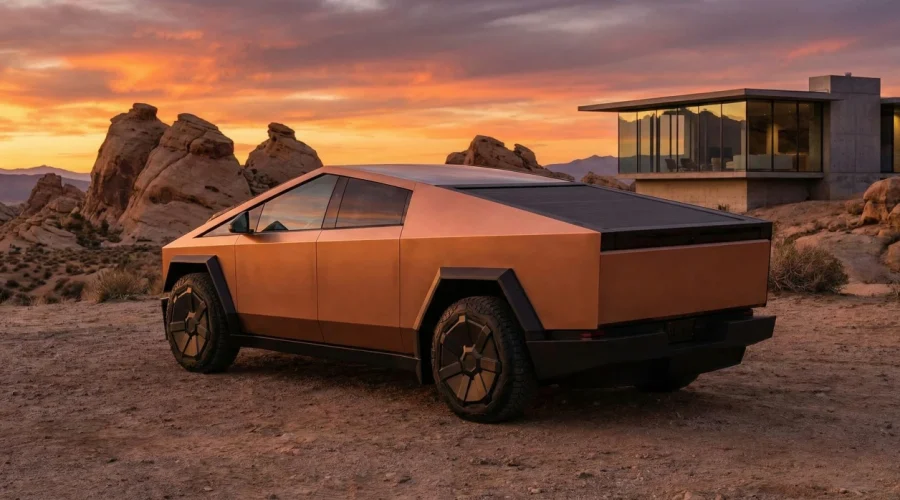
Tesla Cybertruck Wrap Cost 2026: Prices, Colors & Stainless Steel Realities
The Cybertruck’s stainless steel body looked great in the reveal render. Then people started living with it. Fingerprints everywhere. Water spots that won’t wipe off. Micro-pitting in humid coastal climates. Early orange spotting that Tesla owners euphemistically call “surface discoloration.”
A wrap on the Cybertruck isn’t just about color anymore — it’s increasingly bought as a protective layer against a surface that turns out to be pretty high-maintenance in its naked state. And the pricing dynamics are unusual: Tesla sells its own factory-applied wraps for $6,500–$7,500, which means independent installers are competing directly with the manufacturer. That changes the conversation.
What a Cybertruck Wrap Actually Costs in 2026
| Coverage | Independent Installer | Tesla Factory Program |
|---|---|---|
| Partial (high-wear zones, panels under 30%) | $1,400–$2,400 | Not offered |
| Standard matte/satin full wrap | $3,800–$5,200 | $6,500 (Stealth) |
| Premium satin colors / pearls | $4,500–$6,000 | $7,000 (satin finishes) |
| Color shift / chrome / exotic | $5,800–$7,500 | Not available |
| Full clear PPF (alternative) | $4,500–$8,500 | Varies by market |
The numbers tell a clear story: independent installers undercut Tesla’s factory wrap program by $1,500–$2,500 for comparable finishes. And independents offer color-shift and chrome options that Tesla doesn’t sell at all.
Tesla’s factory wrap has the advantage of being applied in a controlled environment and backed by Tesla’s name. But the independent installer route gives you more color options, often better quality film (3M, Avery, KPMF vs. Tesla’s unbranded film), and meaningful cost savings. For general wrap economics, see the car wrap cost guide.
Why Stainless Steel Changes Everything
This section doesn’t exist anywhere else on our site, because no other vehicle wraps onto bare stainless steel.
Here’s what makes the Cybertruck different at a material level:
Traditional vinyl adhesive chemistry is formulated for automotive paint. Factory car paint has a polyurethane clear coat that vinyl adhesive is designed to bond with. The Cybertruck has no paint, no clear coat — just raw cold-rolled stainless steel with a surface finish. The adhesive still works, but it behaves differently.
3M and Avery have both released updated primer guidance for Cybertruck applications. The major film manufacturers acknowledged early on that their standard application procedures needed modification for the Cybertruck. Proper surface preparation is more critical here than on any painted vehicle.
Removal is actually easier on stainless than on paint. This is a genuine upside. Because there’s no clear coat to damage, vinyl comes off stainless with less residue and less risk of surface damage than on a painted car. The caveat: you need slower heat application during removal. Rushing it can leave adhesive ghosts that are harder to clean off bare stainless than off paint.
The body panels are NOT painted underneath. Unlike a DeLorean (which has a painted steel body under stainless panels), the Cybertruck’s stainless IS the body. If a wrap fails or gets damaged, you’re back to bare stainless — there’s nothing else underneath. No primer, no paint, no second chance.
Installers who haven’t wrapped a Cybertruck should not be your first call. This isn’t gatekeeping. The material is genuinely different enough that a shop’s first Cybertruck will be a learning experience. You don’t want to pay for that learning curve.
Popular Cybertruck Wrap Colors
The Cybertruck wrap scene has its own distinct preferences that don’t overlap much with sedans or trucks:
Matte Black (Stealth) — The dominant choice by a wide margin. Matte black on the Cybertruck’s angular body creates a look that photos don’t do justice. It’s the single most popular Cybertruck wrap for a reason.
Full-Body Color Shift / Chameleon — Disproportionately popular on Cybertrucks compared to other vehicles. The flat geometric panels make color-shift films look like they were made for this truck. Huge in the LA scene.
Matte White / Satin Pearl — Clean and emerging as a popular alternative for owners who want the angular aesthetic without the stark stainless look.
Satin Khaki / Military Tones — Borrowed from the truck/Wrangler scene. Looks surprisingly natural on the Cybertruck’s utilitarian shape.
Avoid gloss finishes unless you know exactly what you want. Gloss wraps on a Cybertruck tend to compete visually with the stainless accents and panel edges, and often end up looking worse than the stock finish. Matte and satin are the sweet spot for this vehicle.
For a wider look at color trends, check popular car wrap colors.
Full Wrap vs. Partial Wrap Strategy
Cybertruck owners approach partial wraps differently than owners of any other vehicle, and it’s worth understanding why.
On a traditional car, a partial wrap usually means hood + roof + mirrors — cosmetic accent zones. On a Cybertruck, the partial wrap conversation is about protection zones: the tonneau cover area, lower panels and wheel arches, the front fascia — spots where road debris, parking lot dings, and trail use cause the most surface damage.
Many owners keep the raw stainless aesthetic on the upper body panels (where it looks best) and wrap only the high-wear lower zones. This costs $1,400–$2,400 and addresses the practical concerns without hiding the stainless entirely.
It’s an unusual strategy compared to other vehicles, and it works specifically because the Cybertruck’s design language already incorporates contrast between surfaces. A two-tone wrapped/unwrapped Cybertruck doesn’t look like a mistake — it looks intentional.
What About PPF Instead of a Wrap?
Clear PPF (paint protection film) on a Cybertruck is a legitimate alternative for owners who want the raw stainless look preserved but protected from fingerprints, water spots, and micro-pitting.
Full-body clear PPF runs $4,500–$8,500 — so it’s not cheaper than a color wrap. But it solves the maintenance problem without changing the appearance. XPEL, SunTek, and 3M all offer clear PPF formulated for the Cybertruck’s stainless surface.
Finding a Cybertruck-Experienced Installer
This matters more on a Cybertruck than on any other vehicle we cover. The stainless steel surface, adhesive considerations, and unique panel geometry mean generic wrap experience doesn’t fully transfer.
Cities where Cybertruck wrap demand is concentrated — and where you’ll find the most experienced installers — include Los Angeles, Austin, Miami, Dallas. Check those city directories for shops that specifically mention Cybertruck experience.
When evaluating shops, ask how many Cybertrucks they’ve completed. If the answer is fewer than five, ask to see photos of their work. The difference between an experienced Cybertruck installer and one figuring it out is visible in the panel transitions.
Get a Quote
Frequently Asked Questions
Does Tesla’s factory Cybertruck wrap cost more than an independent wrap?
Yes. Tesla charges $6,500 for Stealth Matte and around $7,000 for satin colors. Independent installers typically deliver comparable finishes for $3,800–$6,000. The trade-off is that Tesla’s wrap is applied in their controlled facility, while independent quality varies by shop. Choose a Cybertruck-experienced independent and you’ll generally get better results for less money.
Can you wrap a Cybertruck yourself, or does it require a specialist?
It requires a specialist. The stainless steel surface needs specific preparation that differs from painted vehicles, and the large flat panels are deceptively tricky — any imperfection on a flat surface is immediately visible. DIY Cybertruck wraps have a high failure rate even among experienced hobbyists.
Do wraps damage the stainless steel when removed?
No — removal on stainless is actually less risky than on painted cars. There’s no clear coat to damage. Adhesive residue can occur but cleans off stainless more easily than off paint. Proper heat application during removal is key.
Should I wrap my Cybertruck to prevent rust and fingerprints?
A wrap addresses both concerns effectively. Fingerprints are eliminated (you’re touching vinyl, not stainless), and the vinyl layer prevents the moisture exposure that causes surface discoloration. For fingerprint-only concerns, clear PPF is another option that preserves the stainless look.
What colors are most popular for Cybertruck wraps?
Matte black is the runaway leader, followed by color-shift/chameleon wraps and satin pearl white. Matte and satin finishes work best on the Cybertruck’s angular panels — gloss finishes tend to conflict with the raw industrial aesthetic.

