
How to Choose a Car Wrap Shop Near You: 10 Things to Check (2026)
Finding a car wrap shop near you is the easy part. Finding one that won’t butcher your paint job, ghost you after the deposit, or hand you back a vehicle that looks like it got dressed in the dark — that’s the real challenge.
The wrap industry has exploded over the past five years, and with that boom came an avalanche of overnight operators who watched a few YouTube tutorials and decided they were professionals. Some of them are genuinely talented. Others are armed with a heat gun and a prayer.
I’ve spent the better part of two decades covering the automotive aftermarket, and I’ve walked through hundreds of wrap facilities — from million-dollar operations with climate-controlled bays to guys literally working out of storage units. The gap in quality between the top and the bottom of this industry is wider than the Grand Canyon, and your car’s paint is caught in the middle.
This guide exists to give you a reliable checklist so you don’t learn these lessons the expensive way. Whether you’re shopping for a full color change, a commercial fleet wrap, or just a simple chrome delete on your Tesla, the vetting process is the same. Let’s walk through it.
1. Check Their Car Wrap Portfolio — But Look at the Right Things
Every shop has an Instagram page. Every shop posts the hero shots — the car sitting in perfect lighting at a 45-degree angle, glistening like it just rolled off a showroom floor. Those photos tell you almost nothing.
Here’s what separates the wheat from the chaff: ask to see the edges. Specifically, ask for close-up photos (or better yet, an in-person look) at the following areas:
- Door handle recesses: Is the vinyl cleanly tucked around the handles, or is it bridging across the gap like a hammock?
- Bumper corners and headlight wraps: These are the tightest, most unforgiving curves on any vehicle. Wrinkles here are a dead giveaway of an amateur installation.
- Hood and fender seams: The vinyl should be wrapped around the edge and tucked underneath. If it’s trimmed flush with the edge, it will lift within weeks.
- Mirror caps: These compound curves are notoriously difficult. A pro makes them look effortless. A rookie makes them look like a crumpled napkin.
If the shop can only show you beauty shots from fifteen feet away, treat that the same way you’d treat a used car listing with only two blurry photos. They’re hiding something.
**
The “Monday Morning” Test
A trick I learned from a veteran installer in Houston years ago: visit the shop on a Monday morning without an appointment. The bays will be full of cars in various stages of completion. You’ll see the real workflow — how organized the space is, how the team communicates, how they handle the vehicles. A Saturday afternoon Instagram photoshoot tells you what a shop wants to be. A Monday morning walk-through tells you what it is.
2. Demand Climate-Controlled Car Wrap Facilities
This is non-negotiable and I will die on this hill.
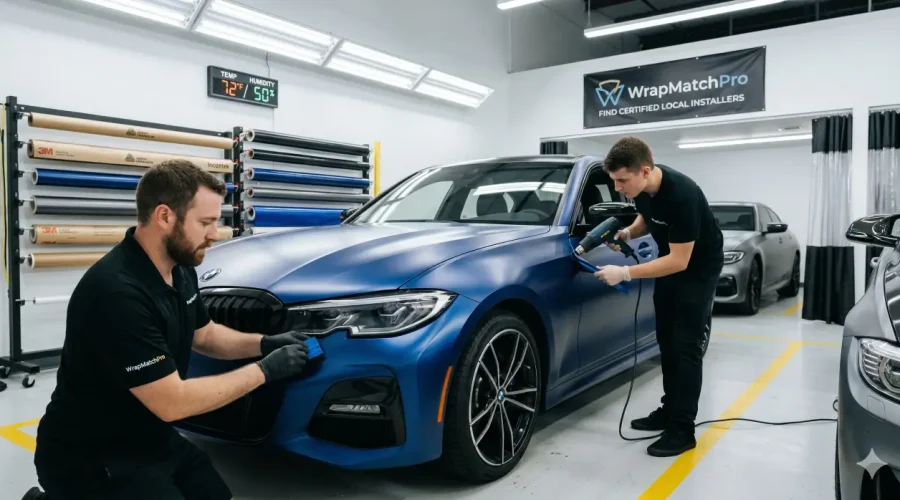
Vinyl film is a living, breathing material. It reacts to temperature, humidity, and airborne contaminants in real time. If a shop is installing wraps in an open garage bay in July with the door rolled up, the dust settling on the adhesive will create tiny bumps trapped beneath the film — a condition installers call “contamination.” Those bumps don’t show up on day one. They show up two weeks later, after the adhesive has fully cured, and by then your warranty claim becomes an argument.
The ideal wrap facility maintains the following conditions:
| Condition | Professional Standard |
| Temperature | 68–77°F (20–25°C) |
| Humidity | 40–60% relative humidity |
| Air filtration | Positive-pressure filtered air (no open bay doors during install) |
| Lighting | Full-spectrum LED banks (to spot imperfections in real time) |
If you walk into a shop and the install bay feels like a sauna or looks like a dust bowl, thank them for their time, walk out, and keep looking. No amount of skill can overcome physics.
3. Ask About Vinyl Wrap Material Brands — Then Verify
A common bait-and-switch in this industry works like this: the shop quotes you using premium material names like 3M 2080, Avery Dennison, or Inozetek during the sales conversation, then quietly substitutes a cheaper Chinese-manufactured film during the actual installation. You won’t notice the difference on day one. You’ll notice it in month four when the color starts to fade and the edges begin to curl like old wallpaper.
How to protect yourself:
Ask the shop to show you the actual rolls of material they’ll be using on your car — before the work begins. Every major manufacturer prints batch numbers and brand logos directly on the backing paper. If the installer can’t show you a branded roll, or if they dodge the question entirely, that’s your cue to leave.
For reference, the current top-tier material brands in 2026 are 3M, Avery Dennison, Inozetek, KPMF, and Hexis. If you’re getting a paint protection film (PPF) instead of vinyl, the gold standards are XPEL, SunTek, and 3M Scotchgard Pro.
4. Understand What a “Certified Installer” Actually Means
The word “certified” gets thrown around like confetti in this industry, and it means different things depending on who’s saying it. Here’s the pecking order, in plain English:
- Manufacturer-Certified (3M, Avery, XPEL): This is the real deal. These certifications require the installer to attend hands-on training courses conducted by the material manufacturer, pass practical exams, and in many cases, submit completed work for evaluation. A 3M-certified shop has direct access to 3M’s warranty programs.
- Industry-Certified (PDAA, WrapInstitute): Organizations like the Professional Decal Application Alliance and the United Application Standards Group offer certification programs that test an installer’s general competency across multiple material brands. This is a solid credential.
- “Self-Certified” or “Trained”: This means nothing. It means the person watched the manufacturer’s videos or attended a one-day seminar. It carries no warranty backing and no accountability.
5. Get the Full Scope of the Wrap Job in Writing
The number one source of disputes between customers and wrap shops isn’t the quality of the vinyl or the color match. It’s mismatched expectations about what’s included. Before you sign anything or hand over a deposit, make sure the written quote explicitly covers:
- Hardware handling: Full disassembly and reassembly of exterior hardware (door handles, mirrors, badges, lights).
- Surface prep: Surface decontamination (clay bar or chemical prep).
- Materials: The specific vinyl brand and color code being used.
- Door jambs: Whether door jambs are being wrapped (many shops skip these to save time — and it looks terrible when you open the door).
- Post-heat treatment: The installer goes over every edge and seam with a heat gun after installation to “set” the memory of the vinyl and prevent lifting.
- Warranty terms: What’s covered, for how long, and what voids it.
If the quote is a single line that reads “$3,500 — Full Wrap” with no detail, that’s not a quote. That’s a handshake and a hope. Get the specifics nailed down.
6. Ask Specifically About Their Experience With Your Vehicle
This one catches people off guard. You’d assume that any shop capable of wrapping a Ford Mustang can wrap a BMW 3 Series. Same general size, same general shape, right?
Dead wrong.
Every vehicle has unique pain points that only become apparent through repetition. Tesla owners know this better than anyone — the ultra-tight panel gaps, the flush door handles with embedded electronics, the massive panoramic glass roof that vinyl can’t adhere to. An installer who has wrapped fifty Tesla Model 3s knows exactly where the trouble spots are and has developed techniques to handle them.
The question to ask: “How many [your vehicle make/model] have you wrapped in the past year?” You want double digits.
7. Read Car Wrap Shop Reviews — But Read Them Like a Mechanic
Five-star Google reviews are easy to collect. Most people write something generic like “Great work, fast service!” That tells you nothing. Here’s how to actually mine reviews for useful intelligence:
- Look for the three-star reviews: These are written by people who were mostly satisfied but had a specific complaint. Those complaints (a seam that lifted, poor communication) reveal the shop’s weak spots far more accurately than glowing five-star entries.
- Search for responses: A shop that responds defensively (“That’s not our fault”) is showing you how they’ll treat you if something goes wrong. A shop that responds professionally demonstrates accountability.
- Check for patterns: One complaint about peeling edges is an anecdote. Five complaints about it is a pattern.
8. Compare Car Wrap Quotes (And Avoid the Cheapest)
I’ve said this before and I’ll keep saying it until I’m blue in the face: the cheapest wrap quote is almost always the most expensive mistake.
If someone is quoting you $1,200 for a full wrap in 2026, they are either using bottom-shelf calendered vinyl that will shrink within six months, or they’re cutting corners on labor (skipping disassembly, skipping prep, and trimming edges instead of wrapping them).
Here is a quick look at what you are actually paying for:
| Feature | Cheap Wrap Shop ($1,200 – $1,800) | Professional Shop ($2,500 – $4,500+) |
| Material Quality | Cheap, unbranded or calendered vinyl | Premium cast vinyl (3M, Avery, etc.) |
| Surface Prep | Basic wash, no clay bar | Full chemical decon & clay bar |
| Disassembly | Knives used around lights/handles | Badges, handles, & lights safely removed |
| Edge Finish | Cut flush with the panel edge | Tucked behind the panel for longevity |
| Expected Lifespan | 6 to 12 months before failure | 5 to 7 years with proper care |
The smart approach: Get three quotes from reputable shops. Throw out the lowest and the highest. The middle quote is usually the fairest representation of what the job actually costs. Read our car wrap price guide to learn more
**
9. Visit the Wrap Shop In Person Before Committing
I cannot stress this enough. Do not choose a wrap shop based solely on their website and a phone conversation. Go see the space.
- What a professional facility looks like: The floors are clean. The vehicles inside are covered or parked in designated bays. There’s an obvious organization system for rolls of vinyl. There are completed vehicles you can inspect up close.
- What a red-flag facility looks like: The bay is cluttered with half-finished projects. There’s no clear separation between the prep area and the install area. The person you’re talking to can’t explain the difference between cast and calendered vinyl.
Trust your gut. If the shop doesn’t feel right, it probably isn’t.
10. Understand the Vehicle Wrap Warranty — Before You Need It
A warranty is only as good as the shop honoring it. Before you hand over your keys, get crystal clear on the following:
| Coverage | Industry Standard |
| Material defect (fading, cracking) | 5–7 years (manufacturer warranty) |
| Installation defect (lifting, peeling) | 1–3 years (shop warranty) |
What typically voids the warranty:
- Running the car through a brush car wash
- Pressure washing the edges or seams
- Applying improper aftermarket waxes or solvents
The critical question: “If a section of the wrap fails within the warranty period, do you re-wrap the affected panel at no cost, or do you only cover materials?” Some shops will only replace the vinyl itself but charge you labor for the re-installation. Get full coverage in writing.
The Bottom Line
Choosing a car wrap shop isn’t like choosing a restaurant. A bad dinner is forgotten by morning. A bad wrap lives on your car for years — peeling, fading, and silently damaging your paint underneath. The vetting process takes an afternoon. The consequences of skipping it last for the life of the wrap.
Do the homework. Visit the shop. Ask the uncomfortable questions. Look at the edges, not the hero shots. And never let price be the only factor in your decision.
Ready to find a vetted wrap installer near you? Check out our complete guide to vehicle wraps. Use WrapMatchPro to browse certified shops in your city, compare real portfolios, and request transparent quotes — no guesswork, no roulette wheel.
Find wrap shops by city:
- Houston, TX car wrap installers
- Dallas, TX car wrap shops
- Los Angeles, CA vehicle wraps
- Atlanta, GA car wrap installers
- Austin, TX
- Miami, FL
- Las Vegas, NV
Frequently Asked Questions
How do I find a good car wrap shop near me?
Start by checking their portfolio for close-up edge work, verify they use a climate-controlled facility, confirm the vinyl brand they use, and read three-star reviews for honest feedback. Visit in person before committing.
How much should a professional car wrap cost in 2026?
A full color-change wrap on a mid-size sedan typically ranges from $2,500 to $4,500 using premium cast vinyl. Specialty finishes like chrome or chameleon can push that to $6,000 or more. If a quote seems dramatically lower than the market average, ask what corners are being cut.
What is the difference between cast and calendered vinyl?
Cast vinyl is manufactured as a liquid poured onto a sheet — it has no memory and won’t shrink over time. Calendered vinyl is rolled from a solid, like dough, and retains a memory that causes it to shrink on curved surfaces. Professional shops use cast vinyl for vehicle wraps.
Should I get my car wrapped at the dealership?
Most dealerships outsource wrap work to a third-party installer and add a markup. You’ll almost always get better results and a lower price by going directly to a dedicated wrap shop.
How long does a professional car wrap last?
A high-quality cast vinyl wrap installed by a certified professional typically lasts five to seven years with proper maintenance. Paint protection film (PPF) can last seven to ten years. Cheap vinyl or poor installation can fail in as little as six months.

