
Tesla Model 3 Wrap Cost 2026: Real Prices by Color & Finish
Tesla sells six paint colors. Six. If you bought a Model 3 and want something that doesn’t look like every other one in the grocery store parking lot, a wrap is basically the move. Stealth gray, satin black, color-shift purple — the colors that actually turn heads aren’t in Tesla’s configurator.
But here’s what most wrap guides skip: the 2024 Highland refresh changed what wrapping a Model 3 actually involves. New body lines, flush door handles, redesigned bumpers — it’s not the same car underneath the vinyl anymore. If you’re pricing a wrap and nobody’s asked you whether your Model 3 is a Highland, find a different installer.
See our full Tesla wrap guide for more info on other models.
Get a Quote
How Much It Costs to Wrap a Tesla Model 3 in 2026
Here’s what real shops are charging right now:
| Trim / Year | Partial Wrap (hood+roof+mirrors) | Full Color Change | Premium Finish (satin, matte) | Color Shift / Chrome |
|---|---|---|---|---|
| 2017–2020 Standard Range | $800–$1,400 | $2,800–$3,800 | $3,200–$4,400 | $4,500–$6,000 |
| 2021–2023 Long Range / Performance | $900–$1,600 | $3,000–$4,200 | $3,500–$4,800 | $4,800–$6,500 |
| 2024+ Highland (all trims) | $1,100–$1,800 | $3,400–$4,800 | $3,900–$5,500 | $5,200–$7,200 |
Those ranges come from installer quotes across our directory. Your number will depend on your city, the shop’s backlog, and the specific film brand. For the full breakdown of what drives wrap pricing in general, check our car wrap cost guide — this article sticks to what’s specific to the Model 3.
Why Highland Model 3s Cost More to Wrap
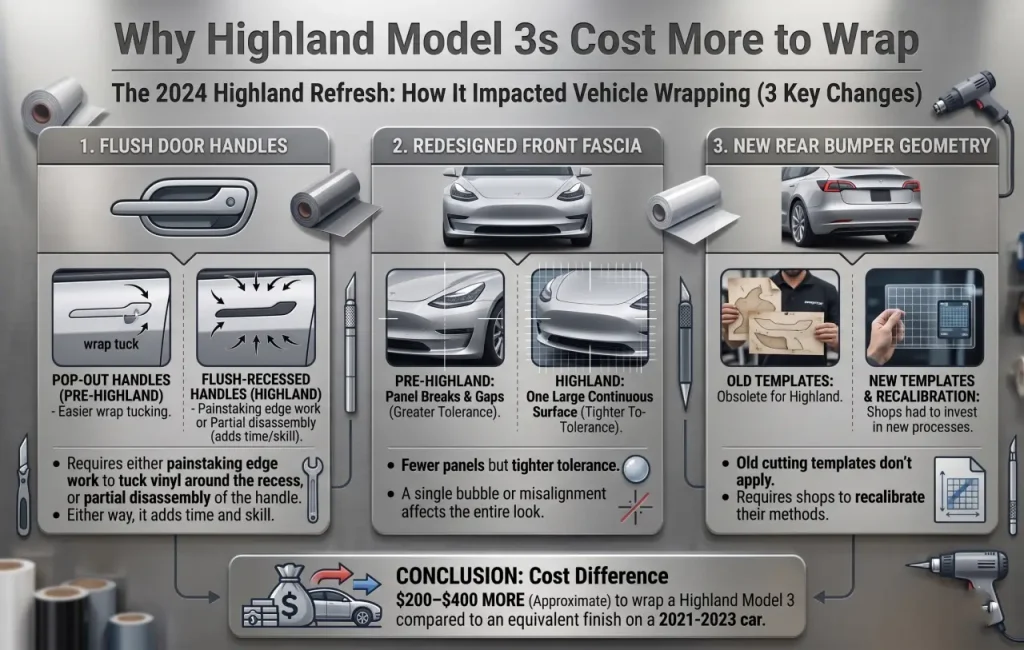
The 2024 Highland refresh wasn’t just a facelift. It changed the wrapping experience in three specific ways:
Flush door handles. The old pop-out handles were easy to work around. The new flush handles sit recessed into the door panel, which means the installer either does painstaking edge work to tuck the vinyl cleanly around the recess, or partially disassembles the handle. Either way, it adds time and skill.
Redesigned front fascia. The Highland front end is one large continuous surface where the old Model 3 had panel breaks. Fewer panels sounds simpler, but it actually means tighter tolerance — one bubble or misalignment on that big panel and the whole front looks off.
New rear bumper geometry. The bumper shape changed enough that old cutting templates don’t apply. Shops that wrapped hundreds of pre-Highland Model 3s still had to recalibrate on the new car.
All told, expect to pay $200–$400 more for a Highland Model 3 wrap compared to an equivalent finish on a 2021–2023 car.
Popular Wrap Colors for the Model 3
Model 3 owners don’t pick wrap colors the same way Mustang or truck buyers do. The choices are driven by what Tesla doesn’t offer:
Satin Stealth Black / Satin Frozen Black — The single most popular Model 3 wrap. Tesla’s Solid Black is the $0 default option, and it looks flat and cheap in person. A satin or frozen black wrap takes the same color and makes it look like a $90,000 car. Night and day difference for $3,200–$4,500.
Satin Pearl White / Satin Frozen White — For owners who love their Pearl White Multi-Coat but want more depth. Subtle upgrade, big visual payoff.
Midnight Cherry / Satin Dark Grey — These mimic factory options that Tesla has offered on higher trims or limited runs. Owners of older Model 3s use wraps to get colors that weren’t available when they bought the car.
Color-Shift (Green/Purple, Blue/Purple) — Huge in the LA and Miami Model 3 scenes. These chameleon wraps shift color depending on the light angle and absolutely get attention. They also cost $5,000+ and require a skilled installer.
Matte Military Green / Olive — An emerging trend, especially on Performance trims. Gives the Model 3 an aggressive, utilitarian look that photographs really well.
Gloss Racing Red / Midnight Metallic Blue — Straightforward color changes for owners who want a traditional car color Tesla doesn’t sell.
Clear PPF — Not technically a color wrap, but worth mentioning. A lot of Model 3 owners just want paint protection without changing the color. If that’s you, check our breakdown of PPF vs. vinyl wrap.
What Makes the Model 3 Tricky to Wrap
Every vehicle has its quirks. The Model 3 has more than most people expect from a car with relatively simple body lines:
The glass roof. Model 3’s panoramic glass roof means the vinyl has to terminate cleanly right at the glass edge. This is where installer skill separates the $2,800 quote from the $3,500 quote. A sloppy glass-edge termination is visible from ten feet away and will bother you every time you walk up to the car.
Flush door handles (Highland). Covered above, but it’s worth repeating — these are the single biggest installation challenge on the 2024+ car. Ask your installer how many Highlands they’ve done before you commit.
Front camera housing and sensor cutouts. Tesla’s Autopilot system uses cameras and (on some model years) ultrasonic sensors embedded in the bumpers and fenders. The wrap has to be precisely cut around these. On older cars with ultrasonic sensors, the cutouts are small and numerous. On newer Tesla Vision-only cars, the front camera housing is the main concern. Either way, the installer needs to know what they’re routing around.
Soft Tesla paint. Tesla’s paint is notoriously thin and soft compared to traditional OEM paint. The upside? A wrap actually protects it better than most OEM paint jobs protect themselves. The downside? Removal is riskier. Aggressive removal technique or cheap adhesive can pull factory paint, especially on early production 2017–2019 cars. This isn’t a reason to avoid wrapping — it’s a reason to choose a shop that knows Tesla paint.
Charge port door. The charge port sits on the rear quarter panel, and the door opens and closes constantly. This area gets the most wear on any Tesla wrap, and it’s common for the edge to lift slightly over time. A good installer reinforces this area, but ask about it specifically.
Does Wrapping Affect Your Tesla Warranty?
This question shows up in every Tesla forum thread about wraps, and the answer is clearer than people think.
A vinyl wrap does not void your Tesla warranty. The Magnuson-Moss Warranty Act prevents any manufacturer from voiding a warranty just because you added an aftermarket modification — unless that modification directly caused the problem you’re claiming. Tesla cannot refuse to repair your drive unit because you wrapped the car purple.
The catch: if a poorly done wrap or a botched removal damages the paint, that paint damage is on you, not Tesla. And Tesla’s paint is soft enough that bad removal can cause real problems. This is one more reason to pick a Tesla-experienced installer.
Tesla service centers have generally been wrap-friendly. Owners report no pushback during service appointments, and wraps don’t interfere with OTA updates or diagnostics.
How Long a Tesla Model 3 Wrap Lasts
A quality wrap on a Model 3 should last 5–7 years with proper care. For the full breakdown of wrap lifespan factors, see our how long does a car wrap last guide.
Two Model 3-specific factors worth noting:
Charge port wear. Because you open and close that charge port door daily (sometimes twice daily if you charge at home and at work), the wrap edge around the port sees more wear than any other spot on the car. Budget for a touch-up on this area around year 3–4.
Glass roof advantage. Here’s a counterintuitive one — the Model 3’s glass roof actually helps your wrap last longer. On traditional cars with painted metal roofs, interior sun exposure heats the roof panel from below and accelerates vinyl breakdown. The Model 3’s glass roof doesn’t transfer heat to vinyl the same way. It’s a small advantage, but it’s real.
Finding a Tesla-Specialized Wrap Installer
Not every wrap shop is a Tesla shop. The sensor cutouts, soft paint, and flush handles (on Highland) mean experience matters here more than on a Honda Accord.
Look for shops that can show you completed Tesla wraps — specifically Model 3s, not just Model S or X. The body geometry is different enough that experience on other Tesla models doesn’t fully transfer.
Cities with the highest Tesla density — LA, Houston, Miami, NYC, Dallas, San Francisco — have the most Tesla-experienced wrap installers. Check our city directories for Los Angeles, Houston, Miami, and Atlanta to find verified shops.
Frequently Asked Questions
How much does it cost to wrap a Tesla Model 3 Highland?
A full color-change wrap on a 2024+ Highland Model 3 runs $3,400–$4,800 for standard colors and $3,900–$5,500 for premium satin or matte finishes. Highland models cost $200–$400 more than pre-Highland cars due to the redesigned body panels and flush door handles.
Can I wrap just the hood or roof of my Model 3?
Absolutely — partial wraps are popular on the Model 3. A hood-only wrap runs $300–$600, a roof wrap is $250–$500, and a hood+roof+mirrors package is typically $800–$1,800 depending on your model year and finish choice.
Will a wrap affect my Model 3 Autopilot sensors?
It shouldn’t, as long as the installer cuts properly around the front camera housing and any ultrasonic sensor locations. A Tesla-experienced shop will know exactly where these are on your specific model year. The wrap doesn’t interfere with camera function — it just needs to not cover the lens.
Should I get PPF or a vinyl wrap on my Tesla Model 3?
If your goal is paint protection and you like your current color, PPF is the better choice. If you want a color change that also protects the paint underneath, go with a vinyl wrap. Some owners do both — PPF on the front bumper and hood (high-impact zones) and a color wrap everywhere else.
How long does a Tesla Model 3 wrap last in California or Texas sun?
In high-sun states, expect 4–6 years vs. the 5–7 year average in moderate climates. Matte and satin finishes tend to show sun damage slightly earlier than gloss. Parking in a garage or using a car cover extends lifespan meaningfully. The charge port area will show wear first regardless of climate.

